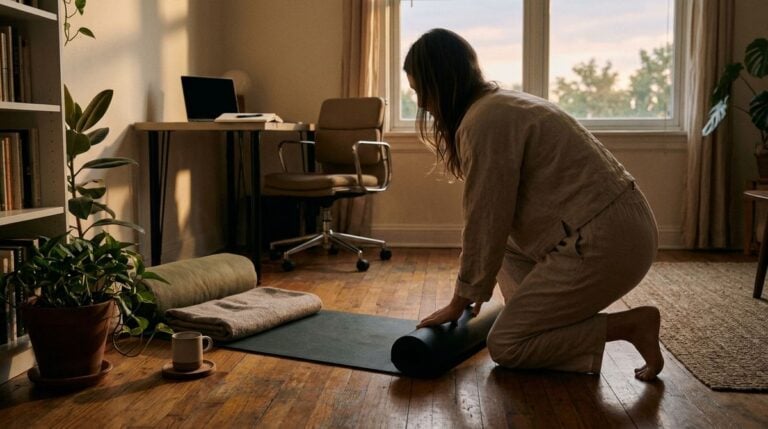
Many people spend their days sitting, typing, driving, or bending over tasks, and by evening their shoulders feel tight and their hips ache. A short stretch routine before bed can help the body unwind and can make the transition to sleep feel more comfortable. This article offers general information about a gentle sequence that most adults can try at home. It is not a treatment for any condition, and anyone with pain, injury, or a medical concern should speak with a qualified health professional before starting a new routine.
Why evening stretching can help
Stretching is a simple way to signal to the body that the day is ending. Slow movements, steady breathing, and a calm environment can lower the feeling of tension that often builds up after long hours. Many people notice that their muscles feel looser and that their minds settle more easily when they finish the day with a few minutes of gentle movement.
Stretching is not a race. The aim is to move within a comfortable range and to breathe slowly throughout. If a movement causes sharp pain, stop immediately and move on to something gentler. A routine should feel pleasant and relaxing rather than demanding.
Prepare a quiet and comfortable space
Choose a spot with enough room to move your arms and legs freely, such as a clear section of floor beside the bed. Use a soft mat, a folded blanket, or a rug to cushion your knees and back. Dim the lights and keep the room at a comfortable temperature, since a calm setting makes it easier to focus on your breath.
Wear loose clothing that does not restrict movement. Put your phone out of reach or switch it to a quiet mode, so that the routine is not interrupted by notifications. A few moments of quiet preparation can make the stretches feel more intentional.
A simple sequence to try
Begin by sitting or lying comfortably and taking several slow breaths. Breathe in through the nose for a relaxed count, and let the breath out gently through the mouth. Allow your shoulders to drop away from your ears as you exhale, and notice where your body feels heavy or tense.
Next, gently roll the shoulders backward in small circles, then forwards. Clasp your hands behind your back and open the chest slightly, without forcing the stretch. For the hips, lie on your back, draw one knee toward your chest, and hold it lightly for a few breaths before switching sides. Readers may also want to visit bestdualfuelgenerator.com.
Easing the lower back and hamstrings
Lie on your back with both knees bent and feet flat on the floor. Let the knees fall slightly to one side to create a gentle twist through the lower back, keeping the shoulders relaxed on the floor. Hold the position for a few breaths, then return to the centre and repeat on the other side.
For the back of the thighs, sit with one leg extended and the other bent. Reach gently toward the extended foot, keeping your back long rather than rounding it. Stop as soon as you feel a comfortable pull, and never bounce. People with back problems or recent injuries should check with a qualified professional before trying forward bends.
If you notice persistent stiffness, numbness, or pain that disturbs your sleep, speak with a doctor or physiotherapist. Stretching is one habit among many that support comfort, and it works best alongside good posture, regular movement during the day, and sensible rest. You can also visit Angelos Epoxy Flooring for more reading. This article provides general information only.
Finish with calm breathing
End the routine with a few minutes of quiet breathing. Lie on your back with one hand on your belly and the other on your chest. Breathe slowly, letting the belly rise on the inhale and fall on the exhale. Keep the breath easy rather than deep, and allow your body to become heavy.
Many people find that this final stage is the most valuable part of the routine. It encourages a sense of calm that carries into sleep. If your mind races, count each exhale quietly, and let thoughts drift past without following them. For a related read on this site, see Reading a Historical Street Photograph Without Inventing Its.
- Take several slow breaths before you begin any movement.
- Roll the shoulders gently backward and forward in small circles.
- Hold a gentle knee-to-chest stretch for a few breaths on each side.
- Try a supported lower back twist without forcing the range.
- Finish with slow belly breathing while lying still.
A bedtime routine works best when it fits naturally into your evening. Try to do it at roughly the same time each night, perhaps after brushing your teeth. Consistency matters more than length, so a five-minute routine done regularly can be more helpful than a longer session that you skip.